
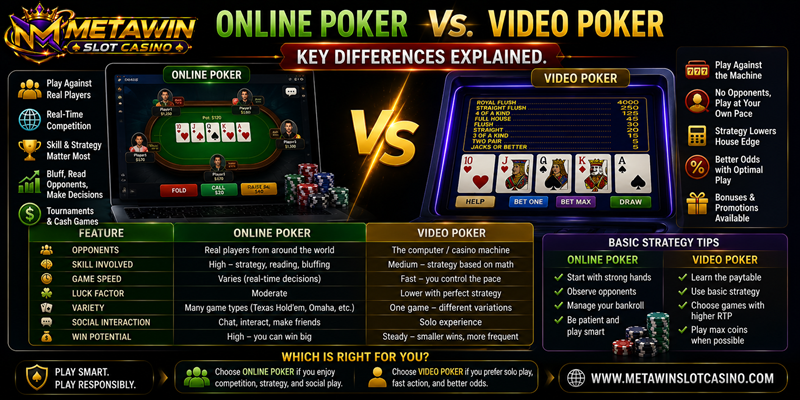
Online Poker vs. Video Poker: Key Differences Explained – Poker remains one of the most popular card games across digital entertainment platforms. However, online casino lobbies feature two distinct formats that share similar hand rankings but operate on completely different mechanical principles: Online Poker (Peer-to-Peer) and Video Poker (Single-Player Fixed Odds).
Online Poker vs. Video Poker: Key Differences Explained
For players navigating online lobbies, confusing these two formats can lead to flawed session strategies. Understanding how opponent interactions function, how payout structures operate, and how mathematical decisions shape outcomes in both variations allows you to select the option that best matches your personal gaming preferences.
The Core Difference: Opponents vs. Fixed Paytables
The fundamental distinction between online poker and video poker rests on who you are competing against during play.
| Operational Dimension | Online Peer-to-Peer Poker | Video Poker |
| Primary Opponent | Other human players seated at the table | Automated casino RNG algorithm |
| Psychological Element | High (Bluffing, position, reading tendencies) | Zero (Purely mathematical decision-making) |
| Payout Mechanics | Variable pots built by player contributions | Fixed multi-tiered paytable multipliers |
| Pacing Control | Dictated by table timers and opponents | Controlled entirely by the individual player |
1. Online Peer-to-Peer Poker Architecture
Online poker (such as Texas Hold’em or Omaha) pits you directly against other human participants. The casino does not take part in the hand outcomes. Instead, the platform acts as a neutral host, collecting a small administrative fee known as the Rake from each pot or tournament entry.
Because you compete against human opponents, psychological factors—such as betting position, bluffing, and analyzing opponent tendencies—play a massive role in your overall success.
2. Video Poker Architecture
Video poker (such as Jacks or Better or Deuces Wild) is a electronic single-player game based on five-card draw poker rules. You play exclusively against a Random Number Generator (RNG) algorithm embedded in the game software.
There are no opponents to bluff, and table position does not exist. Your sole objective is to construct the highest-ranking five-card poker hand possible according to a fixed, pre-published paytable.
Sequential Gameplay Mechanics
Evaluating how a single round progresses in each format highlights the operational contrast between peer-to-peer play and fixed-odds software.
   ONLINE POCKET DEAL   --->  Multi-Street Betting Rounds  --->  Showdown vs. Opponents
   (Texas Hold'em)            (Pre-Flop, Flop, Turn, River)

   VIDEO POCKET DEAL   --->  Single Hold/Discard Phase    --->  Instant Paytable Check
   (5-Card Draw RNG)          (Draw Replacement Cards)
-
Online Poker Execution: A standard Hold’em hand involves multiple betting rounds (Pre-flop, Flop, Turn, and River). Players continuously adjust their decisions—folding, calling, or raising—based on community cards and opponent actions.
-
Video Poker Execution: A video poker round consists of just two quick steps. The software deals five initial cards. You choose which cards to hold or discard, press the “Draw” button to receive replacements, and the software settles your payout instantly against the paytable.
Strategy Profiles: Relative Skill vs. Absolute Mathematics
Both formats reward strategic understanding, but they require vastly different analytical skill sets.
Skill in Online Poker (Relative Advantage)
Success in online poker depends on relative skill. You do not need to play perfectly; you simply need to make better decisions than the specific opponents seated at your table. Strategic elements include:
-
Calculating pot odds and fold equity in real time.
-
Exploiting opponent weaknesses through aggressive position play.
-
Managing table image and varying betting patterns to avoid predictability.
Skill in Video Poker (Absolute Precision)
Success in video poker relies on absolute mathematical execution. Because the software operates on fixed probabilities, every five-card combination has a single, mathematically perfect move (known as Optimal Basic Strategy).
| Video Poker Variant | Target Paytable Format | Theoretical RTP | House Advantage |
| Full-Pay Jacks or Better | 9 for Full House / 6 for Flush | 99.54% | 0.46% |
| Full-Pay Deuces Wild | 15 for 5-of-a-Kind / 25 for Wild Royal | 100.76% | -0.76% (Player Edge) |
| Low-Pay Jacks or Better | 8 for Full House / 5 for Flush | 97.30% | 2.70% |
When executing optimal strategy on a full-pay Jacks or Better game, the house edge drops to an exceptionally low 0.46%. Certain rare variants even offer theoretical returns exceeding 100% under perfect play.
Practical Takeaways for Players
Selecting between online poker and video poker depends on your personal gaming goals:
-
First, choose Online Poker if you enjoy psychological competition, table social dynamics, and outmaneuvering human opponents over multi-stage betting rounds.
-
Second, select Video Poker if you prefer fast-paced, solitary play where strict mathematical rules govern outcomes without external pressure.
-
Finally, always review video poker paytables before wagering, prioritizing “Full-Pay” configurations to ensure maximum statistical returns.
Summary Overview
While online poker and video poker share traditional card hand rankings, they represent entirely different gaming categories. Online poker offers a dynamic, human-versus-human arena where psychology and positional strategy dictate profitability. Conversely, video poker delivers a streamlined, single-player experience grounded in fixed mathematical probabilities. Identifying these key distinctions allows you to select the ideal format for your playing style and session objectives. A Simple Guide to Casino Craps for First-Time Players
About the Author