
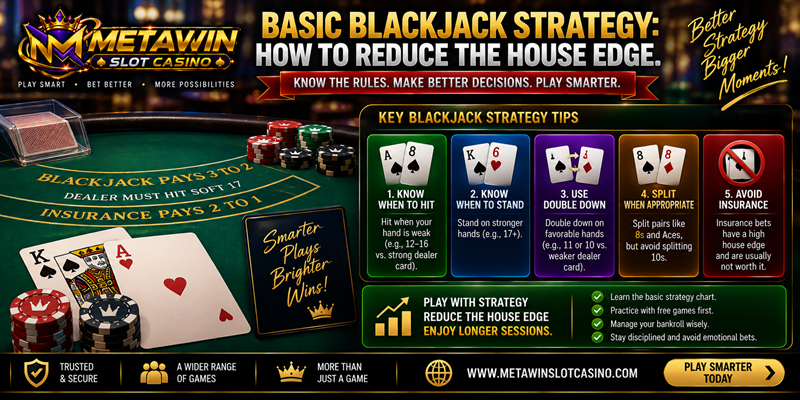
Basic Blackjack Strategy: How to Reduce the House Edge – Blackjack is celebrated across both physical and digital gaming platforms as one of the few casino card games where player choices directly alter the final table results. While games like roulette or video slots depend entirely on automated chance, blackjack blends statistical probabilities with active decision-making. Consequently, adopting a mathematically sound approach known as Basic Blackjack Strategy enables players to compress the venue’s mathematical advantage to under 0.50%.
By grasping how basic strategy principles function, studying critical hand combinations, and choosing favorable table regulations, players can consistently execute decisions that protect their session balance over time.
What Is Basic Blackjack Strategy?
Basic blackjack strategy is a mathematically calculated decision model designed to pinpoint the optimal response for every possible hand scenario. Developed through computer simulations analyzing millions of card deals, this framework evaluates an individual’s current starting hand against the dealer’s exposed upcard.
Consequently, basic strategy removes emotional speculation from the gaming table. Instead of making decisions based on personal instincts, players adhere to strict statistical rules determining whether to Hit, Stand, Double Down, or Split.
| Evaluation Phase | Strategic Focus | Operational Execution |
| 1 | Examine Starting Hand | Calculate total value of active player cards (Hard, Soft, or Pair). |
| 2 | Observe Dealer Upcard | Evaluate dealer strength based on their visible card value. |
| 3 | Execute Matrix Action | Perform the mathematically ideal move (Hit, Stand, Double, Split). |
How Basic Strategy Reduces the House Edge
In standard blackjack sessions, a casual player relying purely on intuition operates against a house advantage ranging between 1.50% and 2.50%. However, consistently applying verified strategy recommendations lowers this operator margin dramatically.
| Decision Methodology | Average House Edge | Impact on Overall Bankroll |
| Unstructured / Intuitive Play | 1.50% – 2.50% | Accelerates balance depletion during long gaming sessions. |
| Basic Strategy Execution | 0.40% – 0.50% | Suppresses the venue advantage to its lowest possible point. |
By preventing tactical missteps, players maximize their long-term winning probability while minimizing unnecessary financial losses over extensive playing sessions.
Core Tactical Guidelines for Hand Scenarios
Basic strategy rules fall into distinct operational categories dictated by hand composition and mathematical expectations:
| Hand Classification | Recommended Strategic Action | Theoretical Reasoning |
| Hard Hand Scenarios | Stand on hard totals of 12–16 when dealer shows 2 through 6. | Avoids busting while forcing the dealer to hit vulnerable upcards. |
| Soft Hand Scenarios | Double down on soft 13 through 18 against dealer 5 or 6. | Capitalizes on Ace flexibility to build higher hand totals. |
| Pair Division Rules | Divide paired Aces and 8-values; retain paired 10s and 5s. | Transforms weak single hands into two strong starting positions. |
| Doubling Opportunities | Double down on hard 11 against any upcard except an Ace. | Leverages high odds of receiving a 10-value card to maximize win size. |
1. Managing Hard Totals (Hands Without a Flexible Ace)
A hard hand contains no Aces or counts an Ace strictly as a single point. When holding a hard total between 12 and 16, drawing another card carries a high risk of exceeding 21. Therefore, if the dealer reveals a weak upcard (2 through 6), the mathematically superior move is to Stand, leaving the dealer to risk busting their hand.
Conversely, when the dealer displays a strong upcard (7 through Ace), players must Hit despite the bust danger, because the dealer is statistically favored to achieve a high hand total.
2. Splitting Pairs Productively
Dividing matched pairs transforms a single hand into two separate betting positions:
-
Always Split Aces: Dividing a pair of Aces creates two opportunities to hit a 10-value card for a strong 21 outcome.
-
Always Split Eights: A pair of 8s equals a difficult starting total of 16. Dividing them creates two independent hands starting at 8, which carry far better theoretical prospects.
-
Never Split Tens or Fives: A pair of 10-value cards produces a solid 20 total, which wins a high percentage of rounds. Similarly, a pair of 5s forms a hard 10, making a Double Down far more profitable than splitting into two weak 5-card starts.
Table Rule Variations Influencing Operator Edge
In addition to playing decisions, specific table rules established by online operators directly alter the baseline house edge:
| Table Regulation Parameter | Player-Favorable Standard | Unfavorable Variation | Net House Edge Modification |
| Natural Blackjack Payout | 3 to 2 Payout Ratio | 6 to 5 Payout Ratio | +1.39% House Edge Increase on 6:5 |
| Soft 17 Dealer Rule | Dealer Stands on Soft 17 | Dealer Hits on Soft 17 | +0.22% House Edge Increase on Hit |
| Double After Split (DAS) | Permitted | Restricted | -0.14% House Edge Reduction when allowed |
As shown in the table above, playing at a table featuring a 6 to 5 blackjack payout raises the house advantage by a massive 1.39%. Consequently, players should select games offering traditional 3 to 2 payouts. Proven Casino Bankroll Management Strategies for Long-Term Wins
Practical Advice for Beginners
To apply basic blackjack strategy effectively during online sessions, adopt these essential habits:
-
First, refer to a verified basic strategy chart during digital sessions to ensure accurate decision-making on every deal.
-
Second, decline Insurance Bets when offered, as this side option carries a punishing house margin exceeding 7.00%.
-
Third, select tables featuring 3 to 2 natural payouts and liberal double-down rules to preserve optimal statistical conditions.
-
Finally, maintain strict bankroll discipline by placing consistent unit bets proportionate to your available balance.
Summary Overview
Basic blackjack strategy is a fundamental tool for any player aiming to improve performance on the digital felt. By consistently following proven decision frameworks for hitting, standing, splitting, and doubling down, players can reduce the house advantage to under 0.50%. Combining basic strategy execution with disciplined budget control and favorable table selection ensures a rewarding, sustainable blackjack experience.
About the Author