
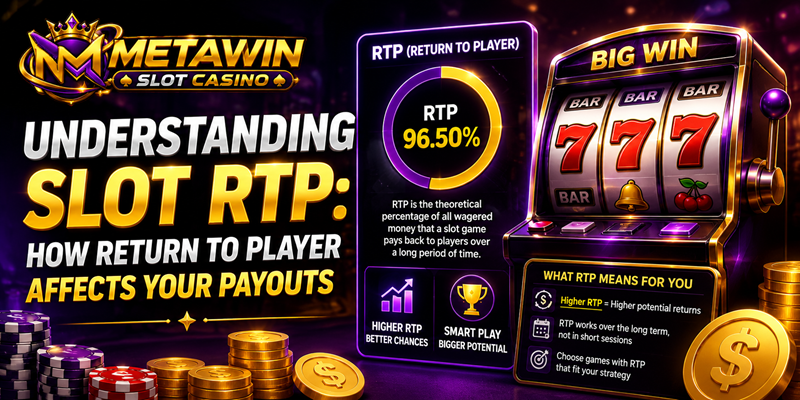
Understanding Slot RTP: How Return to Player Affects Your Payouts – When you explore the digital floor of an online casino, you encounter hundreds of colorful slot titles with diverse themes, bonus mechanics, and jackpot structures. Beyond the visual graphics and immersive sound effects, a fundamental mathematical metric governs every single spin. Industry experts call this core metric Return to Player, or simply RTP.
Understanding how RTP operates is essential for any player who wants to make smart decisions, manage a bankroll effectively, and evaluate potential payout expectations over time.
What Is Slot RTP?
Return to Player (RTP) is a statistical percentage that indicates how much money a slot machine pays back to players over an extended period. Modern online slots usually feature an RTP rating between 92% and 98%. Consequently, this figure clearly shows the mathematical balance built directly into the game software.
For example, if a slot machine carries an RTP rating of 96%, it theoretically returns $96 for every $100 that players wager. Meanwhile, the remaining 4% represents the House Edge. Therefore, this percentage guarantees the casino’s built-in mathematical profit margin over long-term operations.
+-------------------------------------------------------------+
|                     TOTAL WAGER ($100)                      |
+------------------------------+------------------------------+
|       Return to Player       |          House Edge          |
|          96% ($96)           |           4% ($4)            |
+------------------------------+------------------------------+
However, you must remember that developers calculate RTP across millions of hypothetical spins rather than a single session. As a result, short-term outcomes vary dramatically because of natural statistical variance.
The Role of Random Number Generators (RNG)
Modern video slots rely on a core technological system known as a Random Number Generator (RNG). In simple terms, an RNG is an advanced algorithm that creates thousands of random numerical sequences every second. Thus, the system instantly determines the exact outcome of your spin the precise moment you press the start button.
Because every spin creates an independent event, previous spins never influence future results. In addition, the RNG system guarantees two critical factors for every player:
-
Absolute Fairness: Players cannot predict, manipulate, or alter any spin result based on past gaming history.
-
Statistical Alignment: Over a massive scale of millions of spins, the random outcomes converge perfectly to match the programmed RTP percentage.
Furthermore, independent auditing agencies—such as eCOGRA, iTech Labs, and GLI—regularly inspect casino RNG systems to ensure that published RTP figures reflect genuine randomness.
Theoretical RTP vs. Short-Term Variance
A common misconception among casino enthusiasts is assuming that an RTP of 96% guarantees a $96 payout on every $100 spent during a quick gaming session. In reality, short-term outcomes depend entirely on statistical variance or volatility.
   Long-Term Statistical Expectation (Millions of Spins)
===========================================================> [Theoretical 96% RTP]

   Short-Term Session Reality (100 Spins)
-----------------------------------------------------------
   Player A: Spins $100  --->  Wins $400 (High Variance / Win)
   Player B: Spins $100  --->  Wins $10  (High Variance / Loss)
During a brief 50-spin session, one player might trigger a major bonus feature and leave with a 300% return. Conversely, another player might experience a cold streak and lose their initial deposit quickly. Both outcomes represent normal results on a statistical distribution curve. Eventually, as millions of players complete millions of spins, those individual spikes smooth out into the theoretical 96% baseline.
How Volatility Intersects with RTP
While RTP measures how much a slot returns over time, Volatility determines how the game distributes those payouts. Consequently, two different slot games can share an identical 96.5% RTP while offering completely different experiences.
Low Volatility Slots
These games deliver frequent, smaller payouts. Therefore, they offer steady gameplay, protect your bankroll from rapid losses, and provide long-lasting entertainment. As a result, low volatility games work best when you want to complete bonus wagering requirements.
High Volatility Slots
On the other hand, high volatility games pay out less frequently, but they offer significantly larger win potential. Specifically, the game concentrates payouts inside complex bonus features, multiplier sequences, or free spin rounds. Thus, these titles suit adventurous players who accept higher risk while chasing substantial jackpots.
Why RTP Matters for Your Gaming Strategy
Selecting games with higher RTP ratings gives you a clear structural advantage. Therefore, choosing top-rated games remains one of the few logical steps you can take to optimize your overall theoretical return.
| Slot RTP Tier | Percentage Range | Strategic Assessment |
| Below Average | Under 94% | High house edge; typical for physical machines or massive progressive jackpots. |
| Average Industry Standard | 95.0% – 96.0% | Standard baseline for most modern online video slots. |
| Above Average | 96.5% – 97.5%+ | Highly favorable choice for players seeking better long-term statistical odds. |
If you consistently select titles with an RTP above 96.5%, you effectively minimize the house edge. Consequently, your budget lasts longer, and you gain more opportunities to hit high-paying bonus features.
Key Takeaways for Players
Ultimately, understanding slot RTP gives you a realistic, balanced perspective on online slot mechanics. Although RTP cannot guarantee individual session wins, choosing higher-RTP titles reduces the long-term mathematical advantage of the casino, providing the strongest foundation for your gaming sessions.
-
First, always check the paytable or information menu to confirm a slot’s official RTP percentage before playing.
-
Second, balance RTP metrics with volatility settings so the game matches your personal bankroll strategy.
-
Finally, view RTP as a reliable long-term statistical indicator rather than a quick payout promise.
About the Author