Slot Paylines and Megaways Explained: A Beginner’s Guide – When you begin evaluating modern digital slot machines, you quickly discover that scoring a winning combination extends far beyond lining up three matching symbols horizontally. Today’s software engineering studios design games around diverse grid structures, ranging from classic fixed-line pathways to highly fluid reel mechanics.
By understanding how traditional payline arrangements contrast with contemporary Megaways frameworks, you can interpret paytable specifications accurately, evaluate game layouts with confidence, and select titles that match your preference.
What Are Traditional Slot Paylines?
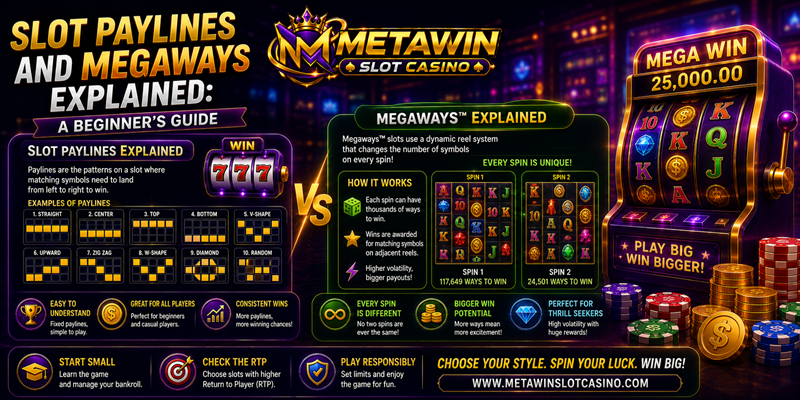
In classic slot game design, a payline represents a dedicated, pre-established visual trace across the reels where matching symbols must stop to release a payout return. Original mechanical slot units featured a solitary straight line running across three reels. Conversely, modern five-reel video slots generally incorporate anywhere from 10 to 50 fixed or selectable payline paths.
+-------------------------------------------------------------------------+
|                     CLASSIC PAYLINE CONFIGURATIONS                      |
+-------------------------------------------------------------------------+
|  Straight Route   : [X] [X] [X] [X] [X]  (Horizontal top/middle line)  |
|  Diagonal Route   : [X] [ ] [ ] [ ] [X]  (V-shaped corner pattern)     |
|                     [ ] [X] [ ] [X] [ ]                                 |
|                     [ ] [ ] [X] [ ] [ ]                                 |
+-------------------------------------------------------------------------+
Fixed vs. Adjustable Payline Systems
-
Fixed Payline Engines: You must wager credits across every available line path on each turn. For example, a 20-fixed-line release automatically activates all 20 path options during every spin.
-
Adjustable Payline Engines: You retain freedom to choose the exact number of active lines you want to bet on per round. However, deactivating lines lowers your total stake while simultaneously reducing your coverage across the reel matrix.
In traditional line-based titles, symbol combinations almost universally compute from left to right, starting strictly from the first reel on consecutive positions along an enabled path.
The Mechanical Evolution: Ways to Win
As software design progressed, developers created the Ways to Win concept (such as 243 Ways or 1,024 Ways) to bypass restrictive line patterns entirely.
Under a “Ways to Win” framework, you no longer require matching symbols to trace geometric line shapes. Instead, the game awards a payout whenever identical symbols land on consecutive reels, regardless of their vertical height, beginning from the far-left reel. This shift simplified payout evaluation for players while expanding multi-combination potential.
What Are Megaways Slots?
Pioneered by Australian software developer Big Time Gaming, the Megaways engine transformed slot mechanics by introducing variable reel dimensions. Unlike standard slots that maintain a rigid layout (such as a permanent 5×3 grid), Megaways games alter the number of symbols shown on each individual reel during every single spin.
+-------------------------------------------------------------------------+
|                     DYNAMIC MEGAWAYS REEL GRID                          |
+-------------------------------------------------------------------------+
|  Reel 1: 3 Symbols  │  Reel 2: 7 Symbols  │  Reel 3: 5 Symbols ...     |
|  (Shifting symbol heights create up to 117,649 ways per turn)          |
+-------------------------------------------------------------------------+
Computing Megaways Combination Totals
A standard six-reel Megaways slot can output anywhere between 2 to 7 symbols per reel on any given rotation. To calculate the aggregate winning ways available for an active spin, the system multiplies the individual symbol counts across all six reels:
Because individual reel heights adjust randomly on every turn, the aggregate number of active winning paths shifts constantly, generating a dynamic and unpredictable playing environment.
Structural Comparison: Paylines vs. Megaways
To summarize the operational distinctions between these two popular systems, review the side-by-side comparison below:
| Technical Aspect | Traditional Paylines | Megaways Framework |
| Grid Architecture | Static (e.g., 5×3 layout) | Dynamic (Shifting symbol counts) |
| Winning Pathways | Preset geometric traces (10–50) | Consecutive reel placement (Up to 117,649+) |
| Payout Requirements | Must follow active line paths | Requires landing on adjacent reels |
| Tumbling Mechanics | Limited occurrence in older games | Standard integration across releases |
| Variance Profile | Typically Low to Medium | Generally High to Extreme |
Essential Guidance for New Players
Navigating diverse slot mechanics requires a logical evaluation process. Consider these strategic recommendations when testing new titles:
   Review Paytable Specifications  --->  Distinguish Line Systems from Megaways
                                                    │
                                                    ▼
   Manage Session Stakes Safely     <---  Evaluate Cascading Symbol Features
-
Examine the Rules Panel First: Open the game info menu to confirm whether the title uses fixed paylines, standard adjacent ways, or a shifting Megaways engine.
-
Utilize Cascading Feature Synergy: Most Megaways releases integrate tumbling (cascading) symbols. When you hit a winning payout, the software removes those winning symbols, letting new icons drop down to potentially form extra winning chains from a single wager.
-
Align Bets with Volatility Levels: Because Megaways titles carry high mathematical variance due to their massive win caps, adjust your stake size downwards to sustain longer session play.
Final Overview
Neither traditional payline systems nor Megaways engines hold an absolute advantage over one another. Standard payline LINK SLOT UG123 deliver straightforward tracking and predictable session rhythm, making them ideal for casual play. On the flip side, Megaways titles offer rapid action, shifting grid layouts, and massive combination potential for players seeking dynamic gameplay.
-
First, select traditional payline slots if you favor clear pattern tracking and steady payout behavior.
-
Second, explore Megaways releases if you enjoy dynamic reel structures, tumbling mechanics, and high-volatility action.
-
Finally, enforce disciplined bankroll limits regardless of the engine mechanics you select.
About the Author