
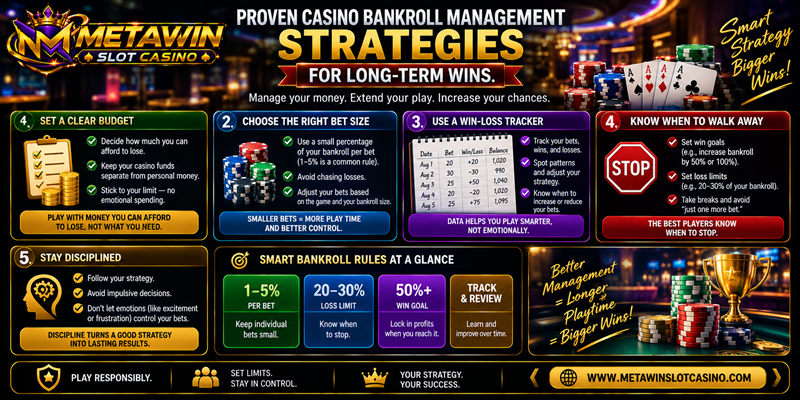
Proven Casino Bankroll Management Strategies for Long-Term Wins – Navigating digital or physical casino platforms successfully requires far more than relying purely on luck or choosing favorable games. Regardless of how well you understand table strategies, unpredictable variance remains an inherent component of all casino games. Consequently, the single most effective tool for extending playing time, mitigating financial losses, and securing sustainable enjoyment is Bankroll Management.
Proven Casino Bankroll Management Strategies for Long-Term Wins
By establishing clear budgetary boundaries, selecting structured betting units, and understanding how mathematical variance affects your balance, you can approach every gaming session with total discipline and financial control.
What Is Casino Bankroll Management?
Casino bankroll management refers to the practice of setting, organizing, and allocating a dedicated sum of money strictly designated for entertainment wagers. Therefore, this capital must remain completely separated from essential daily living expenses, household budgets, and long-term savings.
Proper management prevents players from chasing short-term losses and eliminates emotional decision-making on the felt. Ultimately, the primary objective of bankroll management is not to guarantee individual wins, but rather to ensure that natural negative variance does not exhaust your playing funds prematurely.
Essential Principles for Bankroll Structure
Implementing a resilient financial strategy depends on establishing clear parameters before placing your first wager.
| Core Bankroll Pillar | Practical Definition | Strategic Objective |
| Capital Isolation | Setting aside funds solely dedicated to entertainment. | Protects personal finances from gaming outcomes. |
| Unit Sizing | Dividing total capital into small, equal betting portions. | Prevents rapid depletion during negative swings. |
| Win/Loss Controls | Predetermining concrete exit thresholds for each session. | Locks in profits and prevents emotional loss-chasing. |
The Base Unit Model: Calculating Bet Sizes
A foundational rule of professional bankroll control is the Base Unit Model. Instead of placing arbitrary wager amounts each round, players determine a fixed betting unit calculated as a tiny percentage of their total session bankroll. A Complete Guide to Casino Wagering Requirements and Terms
Consequently, financial experts recommend that a single base unit should represent between 1% and 2% of your total active bankroll.
| Total Available Capital | Recommended Unit Ratio | Base Unit Wager Amount | Total Rounds Provided |
| $500.00 | 1.00% | $5.00 | 100 Betting Units |
| $500.00 | 2.00% | $10.00 | 50 Betting Units |
| $1,000.00 | 1.00% | $10.00 | 100 Betting Units |
| $1,000.00 | 2.00% | $20.00 | 50 Betting Units |
As shown in the table above, allocating 1% per unit provides a buffer of 100 bets. As a result, even during an extended losing streak, your capital remains protected against rapid exhaustion, allowing statistical probability to smooth out over time.
Step-by-Step Session Execution Plan
To execute a disciplined session from start to finish, consider adopting this sequential management workflow:
| Stage | Operational Phase | Specific Action Required |
| 1 | Budget Allocation | Determine total session capital and isolate it in your cashier wallet. |
| 2 | Unit Definition | Calculate your 1% to 2% base unit stake according to overall balance. |
| 3 | Boundary Setting | Establish a firm Stop-Loss Limit (e.g., 50% loss) and Win Target (e.g., 30% gain). |
| 4 | Disciplined Execution | Place consistent unit wagers while avoiding emotional progression bets. |
| 5 | Session Termination | End the session immediately upon hitting either pre-set exit boundary. |
Managing Win Targets and Stop-Loss Boundaries
In addition to fixed unit sizing, setting concrete exit points ensures you walk away from the table at the appropriate moment.
1. Setting a Stop-Loss Limit
A stop-loss limit represents the maximum portion of your bankroll you are willing to lose during a single gaming session. For instance, if you allocate $200 for a session, you might set a stop-loss threshold at $100 (50% of capital). Consequently, if your balance hits $100, you immediately cease playing. This rule eliminates the dangerous temptation to increase bet sizes to chase accumulated losses.
2. Establishing a Win-Goal Threshold
Equally important is establishing a win target (typically a 20% to 50% increase over starting capital). Because the house edge operates continuously over extended play, staying at the table too long eventually erodes short-term winnings. Therefore, locking in profits once your target is reached preserves gains and guarantees a winning outcome for the day.
Actionable Tips for Sustainable Play
To maintain long-term financial discipline while enjoying online casino games, apply these practical recommendations:
-
First, track your wins, losses, and session durations inside a dedicated log or spreadsheet to analyze playing habits objectively.
-
Second, avoid progressive betting systems (such as the Martingale strategy), as doubling stakes after losses can rapidly exhaust your bankroll during cold streaks.
-
Third, take advantage of automated casino account controls, such as daily deposit limits or session time reminders, to enforce personal boundaries effortlessly.
-
Finally, always view casino wagers as a paid form of entertainment rather than an investment vehicle or source of regular income.
Summary Overview
Mastering casino bankroll management is the single most vital skill for any player seeking a sustainable, enjoyable gaming experience. By establishing strict capital isolation, adopting the 1% to 2% base unit betting model, and enforcing mandatory stop-loss and win-goal thresholds, you neutralize emotional impulse and manage natural variance effectively. Consequently, practicing disciplined budget management ensures that you remain in total control of your gaming sessions while maximizing your overall entertainment value.
About the Author