Understanding House Edge: How Casinos Make Money on Games – Casino games offer entertainment through unpredictable outcomes, yet commercial gaming venues consistently generate sustainable profits over time. This ongoing financial success is neither driven by luck nor manipulation, but rather by built-in mathematical principles. At the heart of every casino game lies a concept known as the House Edge.
Understanding House Edge: How Casinos Make Money on Games
Understanding how the house edge operates, how it differs from Return to Player (RTP), and how it affects various table and slot games allows players to make informed choices, manage session budgets effectively, and recognize the true odds behind every wager.
What Is the House Edge?
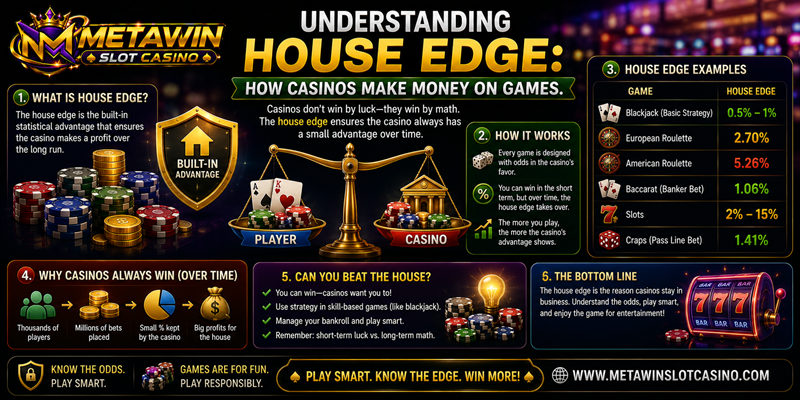
The house edge represents the mathematical advantage that a casino holds over players in any given game. Expressed as a percentage, this metric indicates the average portion of total wagers that the venue expects to retain over millions of individual rounds.
For instance, if a game features a 2.5% house edge, the statistical model projects that the casino will keep approximately $2.50 for every $100 wagered over a massive sample size. The remaining $97.50 is returned to players as winnings. However, this statistical calculation applies across long-term aggregate play, meaning short-term individual outcomes remain subject to random chance and natural variance.
The Core Mechanism: True Odds vs. Payout Odds
Casinos establish their mathematical margin by creating a gap between the actual mathematical probability of winning a bet (True Odds) and the multiplier used to reward a winning bet (Payout Odds).
   Actual Probability of Winning (True Odds)
                     VS
   Multiplier Paid on a Win (Payout Odds)
                     │
                     ▼
      [ GAP = CASINO HOUSE EDGE ]
A clear example of this mechanism occurs on a standard single-zero European Roulette wheel:
| Game Element | Mathematical Reality | Statistical Impact |
| Total Wheel Pockets | 37 Pockets | Numbers 1 to 36 plus a single green “0”. |
| True Odds of Hitting 1 Number | 1 in 37 (2.70%) | Actual probability of winning a single-number bet. |
| Standard Payout Ratio | 35 to 1 | Payout calculates as if the wheel only had 36 pockets. |
| Mathematical Difference | 2.70% Gap | This structural difference creates the 2.70% house edge. |
Because the payout multiplier does not fully reflect the physical odds of winning, the venue secures a permanent mathematical advantage regardless of individual player wins or losses.
House Edge vs. Return to Player (RTP)
When researching online slots or table games, players frequently encounter both House Edge and Return to Player (RTP) metrics. While both numbers describe game statistical returns, they approach the calculation from opposite perspectives:
-
House Edge: Measures the average percentage of total bets retained by the casino operator over time.
-
Return to Player (RTP): Measures the average percentage of total bets paid back to players over time.
| Financial Metric | Mathematical Formula | Example Calculation |
| Return to Player (RTP) | 100% - House Edge |
100% – 3.50% = 96.50% RTP |
| House Edge | 100% - RTP |
100% – 96.50% = 3.50% Edge |
Both metrics represent two sides of the same coin. A game advertising a high RTP naturally carries a lower house edge, offering better statistical value for extended play sessions. European vs. American Roulette: Which Wheel Offers Better Odds?
Comparative Breakdown Across Popular Games
The house edge varies significantly across different game categories and specific betting choices. Certain table games allow strategic decisions that minimize the venue’s margin, whereas luck-based games maintain fixed mathematical parameters.
| Game Category | Specific Bet / Variant | Average House Edge | Player Influence |
| Blackjack | Basic Strategy Rules (3:2 Payout) | 0.50% | High (Optimal decisions reduce edge) |
| Baccarat | Banker Wager | 1.06% | Low (Selecting optimal bet type) |
| Baccarat | Player Wager | 1.24% | Low (Selecting optimal bet type) |
| European Roulette | Single Zero Layout | 2.70% | None (Fixed statistical probability) |
| American Roulette | Double Zero Layout (“00”) | 5.26% | None (Extra zero increases edge) |
| Online Slots | Average Modern Slot Title | 3.00% – 6.00% | None (Determined by game software) |
| Keno | Standard Specialty Card | 20.00% – 25.00% | None (Extremely high built-in margin) |
As shown in the comparison, skill-oriented games like Blackjack yield the lowest house advantage when players execute correct basic strategy decisions. Conversely, games containing additional zero pockets or high house commission structures increase operator margins considerably.
Practical Takeaways for Casino Players
Understanding casino mathematics enables players to make smarter choices while exploring gaming platforms:
-
First, prioritize games with a low house advantage, such as Blackjack or European Roulette, to extend playing time and preserve session funds.
-
Second, study optimal strategy charts for decision-based games to prevent costly errors that increase the operator’s statistical margin.
-
Third, evaluate the published RTP of online slot games before playing, favoring titles that offer an RTP of 96% or higher.
-
Finally, recognize that short-term wins are driven by random variance, but long-term results will always align with the underlying mathematical house edge.
Summary Overview
The house edge is an integrated statistical mechanism that guarantees long-term profitability for casino operators by adjusting payout odds relative to true mathematical probabilities. While players can achieve significant short-term profits during individual sessions due to natural variance, the house edge ensures steady venue returns over millions of rounds. By choosing high-RTP games and applying sound strategic principles, players can minimize the casino’s statistical margin and maximize their gaming value.
About the Author