
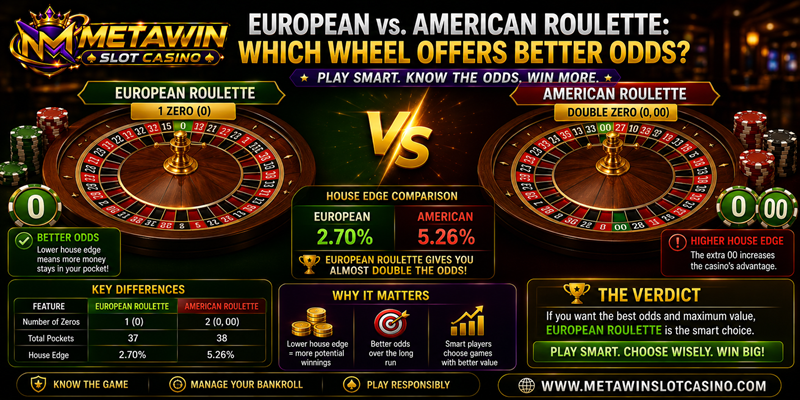
European vs. American Roulette: Which Wheel Offers Better Odds? Roulette stands as one of the most iconic table games in both traditional land-based venues and digital casino platforms. While the foundational concept remains straightforward—predicting which numbered compartment a moving ball will settle into—the specific wheel design you select drastically alters your mathematical expectation of winning. The two most prominent variants dominating the online space are European Roulette and American Roulette.
European vs. American Roulette: Which Wheel Offers Better Odds?
Analyzing the structural differences between these two wheel architectures, evaluating their respective mathematical house advantages, and utilizing favorable localized rules will help you choose the variant that delivers maximum long-term value.
The Core Mechanical Difference: Wheel Pocket Composition
The primary divergence between European and American roulette variants stems directly from the physical design and pocket distribution across the spinning wheel.
| Roulette Variation | Aggregate Pocket Count | Green Zero Breakdown | Primary Numerical Sequence |
| European Architecture | 37 Pockets | 1 Pocket (Single “0”) | Numbers 1 through 36 (18 Red / 18 Black) |
| American Architecture | 38 Pockets | 2 Pockets (“0” and “00”) | Numbers 1 through 36 + Double Zero |
1. European Wheel Layout
The European layout utilizes 37 individual numbered compartments. This configuration features numbers 1 through 36, divided equally between red and black backgrounds, alongside a single green “0” (Zero) compartment.
2. American Wheel Layout
The American layout incorporates 38 individual numbered compartments. While it retains numbers 1 through 36 and the single green zero, the engineering design adds an extra green compartment marked “00” (Double Zero) situated directly opposite the single zero position.
Statistical Analysis: How the Double Zero Increases Casino Edge
In roulette mechanics, payout ratios for winning wagers remain uniform across both variants, calculating wins as if the wheel contained only 36 pockets. For instance, a single-number (straight-up) prediction pays out at 35 to 1 on both wheels. However, because green zero compartments exist, the true mathematical odds of hitting a single number are lower than the payout ratio reflects.
Introducing a second green zero compartment onto the American wheel elevates the venue’s statistical advantage without offering any corresponding increase in payout rewards for participants.
| Analytical Metric | European Format | American Format | Operational Impact |
| Total Pocket Count | 37 Pockets | 38 Pockets | American wheel contains 1 extra space. |
| Single-Number Win Odds | 1 in 37 (2.70%) | 1 in 38 (2.63%) | European offers slightly higher hit rate. |
| Even-Money Win Odds | 48.65% | 47.37% | European provides better outer bet coverage. |
| Base House Advantage | 2.70% | 5.26% | American house edge is nearly double. |
As demonstrated in the comparison table above, adding the “00” pocket elevates the house advantage from 2.70% in European Roulette to 5.26% in American Roulette. Over an extended gaming session, playing on an American layout degrades your session bankroll at nearly twice the rate of playing on a European wheel under identical wagering parameters.
Specialized Rule Mechanics: La Partage and En Prison
Certain European tables—frequently categorized under French Roulette rules—integrate specialized recovery mechanics that further reduce the house advantage on even-money options (Red/Black, Odd/Even, High/Low):
-
La Partage Rule: If a player places an even-money wager and the ball lands directly in the single green “0” pocket, the bet does not result in a complete loss. Instead, the software immediately returns 50% of the initial stake back to the player. This mechanism reduces the effective house advantage on even-money bets to a remarkably low 1.35%.
-
En Prison Rule: Under this protocol, when the ball lands on green “0”, the player’s even-money stake becomes locked (“in prison”) for the subsequent turn. If the original prediction succeeds on the following spin, the player recovers their original stake in full, though no additional profit multiplier is awarded.
In contrast, American roulette tables rarely implement these player-friendly recovery mechanics. Furthermore, American wheels feature a unique five-number combination bet (covering 0, 00, 1, 2, and 3) that carries a punitive house edge of 7.89%, making it one of the mathematically worst wagers on the casino floor. Essential Blackjack Rules: How to Play Like a Pro
Tactical Guidance for Online Sessions
Making informed choices before placing your first wager can significantly improve your gaming experience:
-
First, always prioritize European or French Roulette layouts over American wheels whenever both options appear inside a platform lobby.
-
Second, look specifically for European tables that feature the La Partage rule to optimize your statistical return when placing outer even-money stakes.
-
Third, calculate your session bet sizing around the 2.70% baseline edge, allowing your balance to withstand standard statistical variance.
-
Finally, strictly avoid the five-number basket wager on American tables due to its exceptionally high casino advantage.
Comprehensive Summary
When evaluating European and American roulette side by side, the European variant stands out as the mathematically superior option. By featuring 37 pockets instead of 38, the European wheel maintains a significantly lower 2.70% house advantage, giving players better statistical odds on every single spin. Prioritizing European wheels and practicing disciplined balance control ensures a more rewarding and strategic gaming session.
About the Author